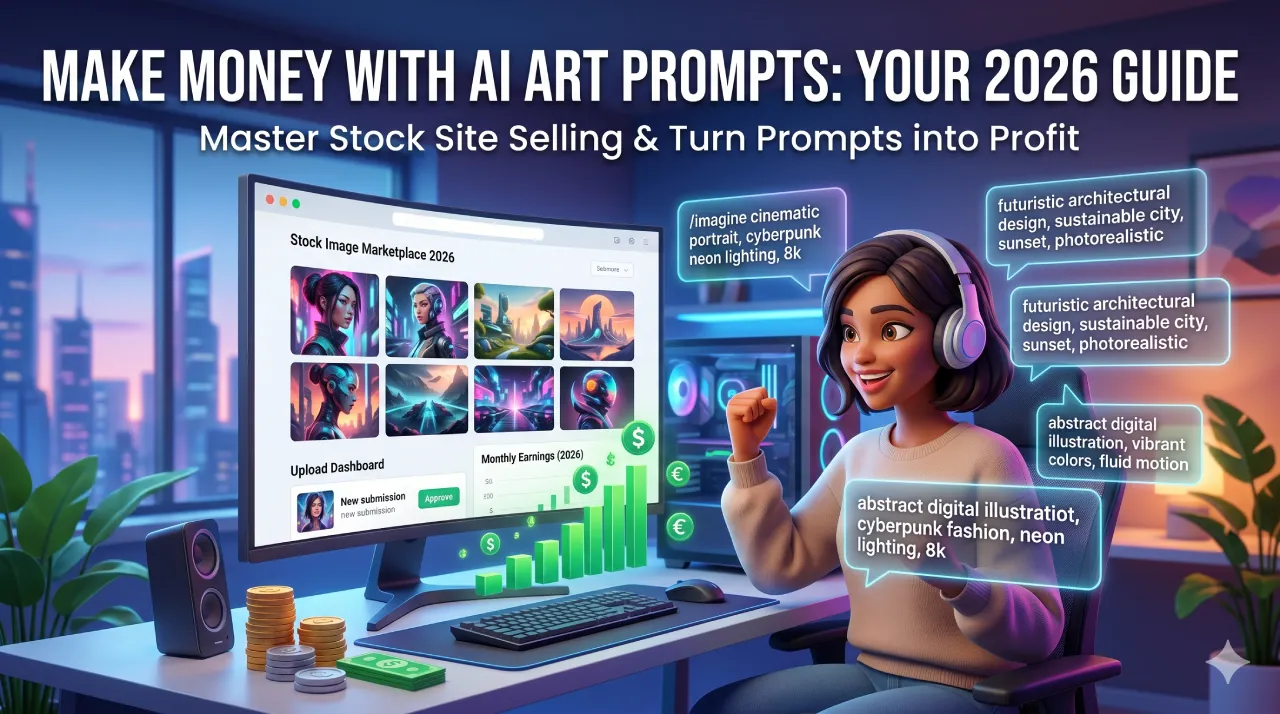
The real money isn’t in the images — it’s in knowing exactly what to ask for. Here’s the prompt strategy, the platforms, and the niches that are generating passive income right now in April 2026.
Most people trying to make money with AI images are doing it backwards. They fire up Midjourney v8 or Flux 2, generate something that looks vaguely cool, upload it to whatever platform accepts AI content, and wait. Nothing happens. The problem isn’t the tool — it’s the prompt. More precisely, it’s that they’re prompting for art when stock sites are buying solutions.
Create high-demand visuals faster with copy-paste AI image prompts that actually sell on stock sites—save time and boost your earnings. Want to go beyond stock platforms? Check our full guide: AI Prompts to Make Money in 2026—covering 7 proven income streams using tools like ChatGPT, Claude, and Gemini.
The AI image market has matured fast. By April 2026, AI-generated images represent an estimated 15–25% of the entire stock photography market — a shift that happened far faster than anyone expected. The good news: the global stock photography market just hit $6.1 billion and is projected to reach $10.1 billion by 2030. There’s still serious money on the table. The bad news: generic content has been commoditized. You can’t just upload abstract gradients and wait for downloads. Buyers are sophisticated, platforms are selective, and the creators who win are those who treat their prompts as precision instruments — not guesswork.
This guide is built on what’s actually working in April 2026 — including current platform policies (Shutterstock’s policy toward AI-generated submissions from contributors has changed), the latest tools, updated earnings data, and a fresh legal landscape shaped by the Supreme Court’s March 2026 ruling on AI copyright.
15–25%
AI images’ share of stock market in 2026
$6.1B
Global stock photo market size (2026)
$300–400
Monthly earnings from 200 Adobe Stock AI images
Why Prompts Are the Real Asset
When you generate an AI image, what you’ve actually created is a repeatable process. A great prompt is like a recipe — run it once, get a sellable image. Run it a hundred times with slight variations, build a library. That library compounds into passive income.
This is why platforms like PromptBase exist. Sellers there aren’t just selling pictures — they’re selling the know-how. A well-crafted stock photography prompt with specific style cues, lighting terms, and subject descriptions can fetch anywhere from $2 to $10 per sale, with no image generation cost on your end once it’s written.
“A prompt that produces one great stock image can produce a thousand variations of it. That’s the leverage traditional photography never had.”
The best AI image sellers in 2026 treat their prompts like intellectual property. They test combinations, track what gets approved and downloaded, and iterate. That said, you don’t need to be technical to start — you just need to think like a stock buyer, not an artist. With tools like Flux 2 and Midjourney v8 now generating studio-grade images in under 5 seconds, the bottleneck is no longer generation speed — it’s prompt quality and niche strategy.
How Stock Sites Work for AI Images in 2026
Platform policies have shifted significantly this year, and knowing where you actually stand is critical before uploading a single image.
Adobe Stock remains the most AI-friendly major platform. It accepts AI-generated images with proper labeling, pays a flat 33% commission on standard licenses, and up to 60% on extended licenses. Contributors with a focused portfolio of 200 AI images have reported $300–400 per month — a real number, not a fantasy. Upload consistently, at least 20–30 images per week, and focus on niche commercial imagery rather than generic concepts.
Shutterstock no longer accepts AI-generated content submitted by contributors. Their platform now runs its own AI image generator and uses contributor-uploaded content to help train it — something that caused significant backlash and contributor exits. If you were building a Shutterstock strategy, redirect that energy toward Adobe Stock, Vecteezy, or Creative Fabrica instead.
Vecteezy actively welcomes AI content and offers a competitive 50% commission rate — the highest among major stock platforms for AI creators. It’s a strong secondary platform to pair with Adobe Stock.
Creative Fabrica has grown rapidly in 2025–2026 as a destination for AI graphics, patterns, and clip art. Its subscription model pays creators based on download frequency, rewarding volume uploaders who can produce themed AI art sets consistently.
Wirestock deserves mention as a distribution layer rather than a platform itself. Upload once and Wirestock distributes to Adobe Stock, Alamy, Depositphotos, and others simultaneously. They take a 15% commission but handle keyword optimization and platform management. For creators who want maximum reach with minimum friction, it remains a useful tool in 2026 — just know they’ve tightened approval requirements as AI submission volume increased.
The core technical requirements haven’t changed: minimum 4MP resolution (8K preferred for premium placement), no visible AI artifacts, no watermarks, no celebrity likenesses, no recognizable brand logos, and a mandatory AI disclosure tag during upload. What has changed is the rejection bar — it’s higher now. Running your images through an upscaler and doing a manual quality check before submission is no longer optional.
What Makes a Prompt “Stock-Worthy”
There’s a clear difference between a prompt that generates something visually interesting and one that generates something commercially useful. Stock-worthy prompts share a few consistent traits.
- They describe the use case, not just the scene. “A confident businesswoman reviewing data on a laptop in a modern open office, natural light from large windows, shallow depth of field, suitable for corporate blog hero image” outperforms “businesswoman at laptop.”
- They specify lighting explicitly. Golden hour, soft diffused daylight, studio lighting with white background — stock buyers have strong lighting preferences and search for them.
- They include compositional intent. “Centered subject with copy space on left” or “wide establishing shot with foreground blur” tells the model what the image is for.
- They avoid overly fantastical or niche aesthetics. Hyper-specific fantasy art sells on Etsy or as prints. Stock sites want versatile images a broad range of buyers can license.
- They request clean, artifact-free output. Adding terms like “photorealistic, sharp focus, no distortion, 8K, clean edges” reduces rejection rates significantly.
High-Demand Niches and Exact Prompt Examples
These aren’t guesses — they’re drawn from the categories that consistently appear in top-seller portfolios on Adobe Stock and Shutterstock. Each niche below is paired with a prompt structure you can adapt immediately.
1. Senior Lifestyle & Health
This is one of the most consistently downloaded categories on every major stock platform. Aging population, healthcare marketing, wellness brands — the demand is structural and won’t dry up.
A healthy senior woman in her 70s laughing while gardening in a sunny backyard, wearing a wide-brimmed hat, vibrant green plants in foreground, natural outdoor lighting, photorealistic, sharp focus, warm tones, no text, transparent background variant available, 8K resolution, Adobe Stock style
2. Remote Work & Technology
The hybrid work economy has created permanent demand for images showing people working from home, video calling, using multiple monitors, and collaborating digitally. The niche is saturated with mediocre images, which means quality still breaks through.
Young professional man working from a minimalist home office, dual monitors showing data dashboards, soft morning light through window, coffee mug on desk, focused expression, shallow depth of field, contemporary interior, photorealistic, copy space on right side, no visible brand logos
3. Mental Health & Wellness Concepts
Abstract and conceptual wellness imagery has exploded with demand from healthcare providers, therapists, wellness apps, and editorial publications. The key is making the concept visually clear without being cliché.
Conceptual illustration of a woman meditating inside a glowing translucent bubble surrounded by soft abstract shapes representing calm and clarity, muted pastel color palette, editorial illustration style, clean white background, no text, suitable for mental health blog or app UI
4. Diverse Business Teams
Authentic, diverse representation in workplace settings is in constant demand. Avoid the generic “people smiling at whiteboard” cliché — buyers are looking for natural, candid-feeling moments.
A diverse group of four colleagues collaborating around a conference table, mixed ethnicities and ages, casual business attire, natural candid expressions, modern glass-walled office, warm ambient lighting, photorealistic, ultra-sharp, no text or logos visible
5. Sustainable Technology & Green Energy
ESG reporting, clean energy startups, environmental journalism — this niche has strong commercial demand and relatively low competition from AI-generated images specifically.
Aerial view of a large solar panel farm in a green field at golden hour, dramatic sky with soft clouds, sense of scale, photorealistic, no people visible, vibrant but natural color grading, horizontal composition with copy space at top, 8K resolution
Food & Nutrition
Overhead flat-lay shots of whole foods, meal prep, and smoothie bowls. Consistently high download rates for health bloggers and recipe sites.
Fintech & Money
Abstract visuals of financial data, digital wallets, crypto, and investment growth. High licensing rates from financial publishers.
Education & E-Learning
Children learning, teachers in classrooms, online course interfaces. Evergreen demand from EdTech brands and publishers.
Real Estate & Interior Design
Clean, aspirational home interiors and architectural shots. Strong licensing from property listings and lifestyle magazines.
Where to Sell: Platform Breakdown
Different platforms reward different strategies. Here’s an honest breakdown of the major options for AI image sellers in 2025.
Adobe Stock ✅
- Accepts AI images (labeled)
- 33% commission standard
- Up to 60% extended license
- 200 images → ~$300–400/mo reported
- Best for: commercial, lifestyle, business
Shutterstock ❌
- No longer accepts AI from contributors
- Runs own AI generator now
- Tiered royalties reset Jan 1 each year
- Redirect efforts elsewhere
- Best for: traditional photography only
Vecteezy ✅
- Actively welcomes AI content
- 50% commission — highest major platform
- Strong buyer base for illustrations
- Best for: vector-style & editorial AI art
Creative Fabrica ✅
- Subscription model — pay per download
- Loves AI clip art, patterns, SVG sets
- Rewards volume uploaders
- Best for: themed AI art bundles
PromptBase ✅
- Sell the prompts, not just images
- Set your own price ($2–$10 typical)
- 450,000+ active buyers
- Best for: niche, high-output prompts
Wirestock (Distrib.)
- Upload once → multiple platforms
- 15% commission on top of platform cut
- Handles keywords & management
- Best for: efficiency at scale
The savviest sellers in 2026 use a layered strategy: upload images to Adobe Stock and Vecteezy for passive royalty income, distribute broadly via Wirestock, sell the underlying prompts on PromptBase, and bundle curated prompt packs on Etsy or Gumroad. Multiple income streams from the same creative work — and none of them require Shutterstock anymore.
How to Keyword Your Images for Maximum Downloads
Keywording is where most AI image sellers leave money on the table. Stock platforms are search engines. Your image doesn’t get discovered by its beauty — it gets discovered by whether your metadata matches what a buyer typed.
Adobe Stock allows up to 50 keywords per image. Use all of them. Think about the image from multiple perspectives: the subject, the emotion, the color palette, the industry it serves, the season, and the composition. For the senior woman gardening prompt above, relevant keywords include: senior woman, healthy aging, retirement lifestyle, outdoor activity, gardening, summer, joyful, real people, candid, natural light, green plants, wellness, active lifestyle, 70s, mature woman, copy space — and so on.
One workflow that top contributors use: screenshot a best-selling image in your niche on Adobe Stock, put it into ChatGPT or Claude, and ask it to generate 49 keyword variations that describe the image from a buyer’s perspective. It takes 30 seconds and dramatically improves discoverability.
Tools to Use in 2026
The AI image generation landscape has matured significantly. The gap between models has narrowed on quality, but each tool still has a clear lane. Here’s where each one sits as of April 2026.
- Midjourney v8 — Still the undisputed benchmark for artistic and cinematic image quality. Version 8 brought native 2K resolution and 4-second generation times. Web interface now available alongside Discord. Starts at $10/month. Best for: editorial aesthetics, lifestyle imagery, concept photography. Weak on embedded text.
- Flux 2 (via Replicate or fal.ai) — The open-weight leader for photorealism in 2026. Exceptional skin texture, accurate lighting simulation, and physically believable detail. Used by photographers and product studios who need studio-grade realism. Available via API at ~$0.015/image. Best for: stock photography requiring hyper-real results and batch automation.
- Adobe Firefly (Image 3/4) — The only major tool trained exclusively on licensed content, giving full commercial indemnification with zero copyright risk. Deep integration with Photoshop and Creative Cloud. Best for: agencies and businesses needing legally bulletproof assets. More restrained creatively than Midjourney, but the safest choice for commercial clients.
- GPT Image 1.5 (via ChatGPT) — Top-tier prompt comprehension and text rendering (approximately 95% text accuracy). Best tool when you need complex scenes or readable words inside images — logos, signs, packaging mockups. Included with ChatGPT Plus ($20/month).
- Ideogram 2.0 — The specialist for images requiring embedded text. If your stock image needs a visible label, sign, or brand element, Ideogram produces cleaner text than any other model. Free tier offers 40 generations per day.
- Stable Diffusion 3.5 (local) — Free to run with a GPU of 12–16GB VRAM. No per-image cost, no API dependency. Steeper setup curve but the most economical choice at volume for technical users.
Realistic Earnings Breakdown for 2026
The market has split into AI-vulnerable and AI-resistant segments. Generic, easily replicable content has seen downloads drop. Niche, well-keyworded, commercially-oriented imagery continues to perform. Here’s what real earnings look like based on current contributor data, not best-case projections.
| Portfolio Size | Est. Monthly Downloads | Est. Monthly Revenue | Realistic Context |
|---|---|---|---|
| 100 images | 10–50 | $10–$30 | Learning phase, testing niches |
| 200 images (focused niche) | 100–300 | $300–$400/mo | Reported by Adobe Stock contributors in 2026 |
| 500 images | 200–600 | $100–$500 | Depends heavily on niche specificity |
| 2,000+ images | 600–2,500 | $300–$1,500+ | Requires automation (Flux + Make.com) |
| Part-time contributors | Varies | $100–$1,000/mo | Consistent uploading + niche focus |
| Top full-time contributors | High volume | $1,000–$10,000+/mo | Years of portfolio building + automation |
The honest picture in 2026: stock photography income is a volume game with a long compounding runway, but it’s not a get-rich-quick scheme. With AI tools, you can build a portfolio faster than was ever possible with traditional photography — but quality over quantity still wins. A tight portfolio of 200 images in an underserved niche on Adobe Stock can outperform 2,000 generic images spread across every platform.
Frequently Asked Questions
The landscape has changed significantly. Adobe Stock, Vecteezy, Creative Fabrica, and Depositphotos all accept AI-generated images with proper disclosure labeling. Shutterstock no longer accepts AI-generated content from contributors as of 2024–2025, having shifted to running its own internal AI generator. Getty Images and iStock also do not accept AI content. Always verify a platform’s current contributor guidelines before uploading, as policies continue to evolve.
For photorealistic stock photography, Flux 2 leads on pure technical quality — exceptional skin texture, lighting simulation, and detail accuracy. Midjourney v8 remains the best for artistic, editorial, and lifestyle aesthetics. Adobe Firefly is the safest legal choice for commercial work, trained exclusively on licensed content with full commercial indemnification. For images requiring embedded text, Ideogram 2.0 is the only model that consistently gets it right. Many professional contributors use two tools: Midjourney for creative direction and Firefly for final commercial assets.
Contributor data from 2026 shows that a focused portfolio of around 200 high-quality, niche-specific images on Adobe Stock can generate $300–400 per month. That’s not a huge portfolio — but niche focus and metadata quality matter more than raw volume. A tight collection in an underserved category consistently outperforms a large, unfocused one. Reaching $500–$1,000+ per month typically requires 500–2,000 images with consistent monthly additions and strong keyword optimization.
Yes — and this is one of the most overlooked income streams for AI image creators in 2026. PromptBase has over 450,000 active users buying prompts, and a well-crafted stock photography prompt pack can generate recurring sales with no additional effort. Etsy and Gumroad are strong platforms for bundled prompt collections, especially for niche categories like coloring pages, print-on-demand, or themed illustration sets. Many creators run a dual strategy: images on stock platforms, prompts sold separately as digital products.
Adobe Stock’s review typically takes 3–7 business days. Rejection rates for AI images have increased as the platform has raised its quality bar in response to the volume of submissions. The most common rejection reasons are AI artifacts (distorted hands, faces, text), inconsistent edges, insufficient resolution, and missing AI disclosure tags. Running images through an upscaler and doing a manual review before submission — particularly checking hands and faces — significantly improves approval rates. Aim for 8K resolution where possible.