You already know ChatGPT can write things. But most freelancers use it like a search engine — one-line questions, generic answers, frustration.
The difference between wasting time and saving hours comes down to one thing: how you prompt it.
This isn’t a list of “ask ChatGPT to write your bio” tips. These are 30 field-tested prompts organized by every stage of your freelance workflow — from finding clients to delivering work to chasing invoices. Each one is written so you can copy it, tweak the brackets, and use it immediately.
This guide focuses specifically on copy-paste ChatGPT prompts for freelancers to help you work faster, save time, and boost your earnings. If you’re looking for a broader strategy that goes beyond freelancing and works across platforms like ChatGPT, Claude, and Gemini, check out our complete guide: AI Prompts to Make Money in 2026 — it covers 7 proven income streams in detail and shows how to scale your earnings using AI.
Let’s get into it.
Section 1: Prompts for Finding & Pitching Clients
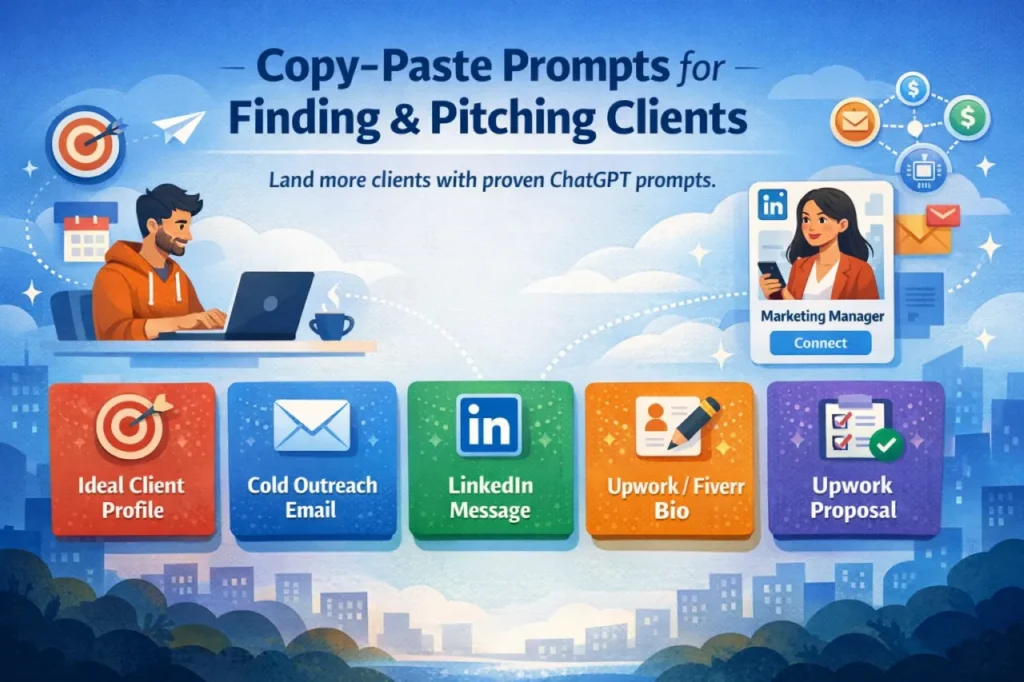
The hardest part of freelancing isn’t the work. It’s getting the work. These prompts help you identify opportunities and show up as the obvious choice.
Identify Your Ideal Client Profile ( Prompt 1 )
Before you pitch anyone, you need to know who’s worth pitching. This prompt builds a laser-focused client profile based on your niche.
i'm a freelance [your skill — e.g., graphic designer, content writer, web developer]. My strongest experience is in [your niche or industry]. Based on this, help me define my ideal client profile. Include: the type of business they run, their team size, the specific problems they face that my services solve, where they typically hire freelancers (platforms, LinkedIn, referrals), and what they care most about when choosing someone to work with.
Write a Cold Outreach Email ( Prompt 2 )
Generic cold emails get ignored. This prompt builds one that’s specific, human, and focused on the client’s problem — not your resume.
Write a cold outreach email to [type of business — e.g., a B2B SaaS startup] for my freelance [your service] services. My email should: open with a specific observation about their business (leave a placeholder for me to fill in), mention one relevant result I've achieved for a similar client, explain exactly what I can do for them, and end with a low-pressure CTA. Keep it under 150 words. Avoid sounding like a template.
LinkedIn Connection Request Message ( Prompt 3 )
Write a LinkedIn connection request message to a [job title — e.g., Marketing Manager at a D2C brand]. I want to introduce myself as a freelance [your skill] and start a conversation without pitching immediately. Keep it under 300 characters, warm, and genuine.
Upwork or Fiverr Profile Bio ( Prompt 4 )
Write my Upwork profile overview for a freelance [your skill] specializing in [your niche]. My target clients are [describe them]. Highlight my strengths as [2–3 key strengths]. Make the tone confident but not arrogant. Open with the client's problem, not my background. Include a soft CTA at the end. Max 250 words.
Job Post Response on Upwork ( Prompt 5 )
Here is a job post I want to apply to on Upwork: [paste the job post]. Write a proposal that: opens with something specific from the post (not 'I read your job post carefully'), addresses their core problem, briefly mentions my relevant experience, and ends with one thoughtful question that shows I've thought about their project. Keep it under 200 words. Sound like a real person.
Section 2: Prompts for Proposals & Pricing
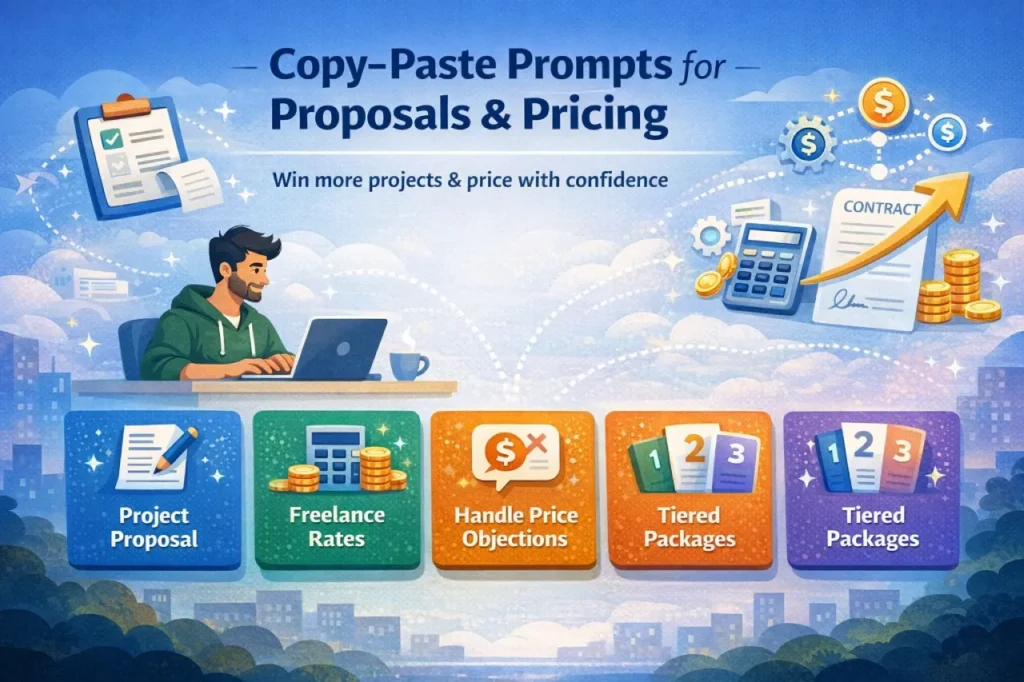
Sending a proposal shouldn’t feel like gambling. These prompts help you structure winning proposals and price your services without second-guessing yourself.
Build a Project Proposal ( Prompt 6 )
Help me write a project proposal for a [type of project — e.g., 3-month SEO content strategy] for a client in [their industry]. Include: a brief summary of their problem as I understand it, the scope of work broken into phases, my deliverables with timelines, what I need from them to get started, and the total investment. Use a professional but approachable tone.
Set Your Freelance Rates ( Prompt 7 )
I'm a freelance [skill] with [X years] of experience in [niche]. My monthly personal expenses come to approximately [amount in INR/USD]. Help me calculate: my minimum viable rate per hour, a competitive market rate based on my experience level, and a premium rate for specialized or rush work. Factor in taxes, unpaid admin time, and a 20% buffer for slow months. Show me both hourly and project-based pricing options.
Respond to “Your Price is Too High” ( Prompt 8 )
A client just told me my rate of [your rate] is too high for their budget. They have a budget of [their number]. Write me a professional, confident response that: acknowledges their budget without apologizing for my rate, explains the value behind my pricing without sounding defensive, and offers one alternative option (like a reduced scope or payment plan). Don't give a discount just to close the deal.
Create a Service Package ( Prompt 9 )
Help me create 3 tiered service packages for my freelance [service]. My ideal client is [describe them]. Package 1 should be entry-level, Package 2 mid-range, and Package 3 premium. For each, list what's included, the price range, and who it's best for. Make the premium package clearly the most attractive without the others looking weak.
Write a Contract Scope of Work ( Prompt 10 )
Draft a professional scope of work section for a freelance contract for the following project: [describe the project]. Include: project overview, deliverables with descriptions, revision policy (maximum 2 rounds), timeline, and what happens if the client requests work outside this scope. Keep the language clear and non-negotiable but professional.
Section 3: Prompts for Client Communication
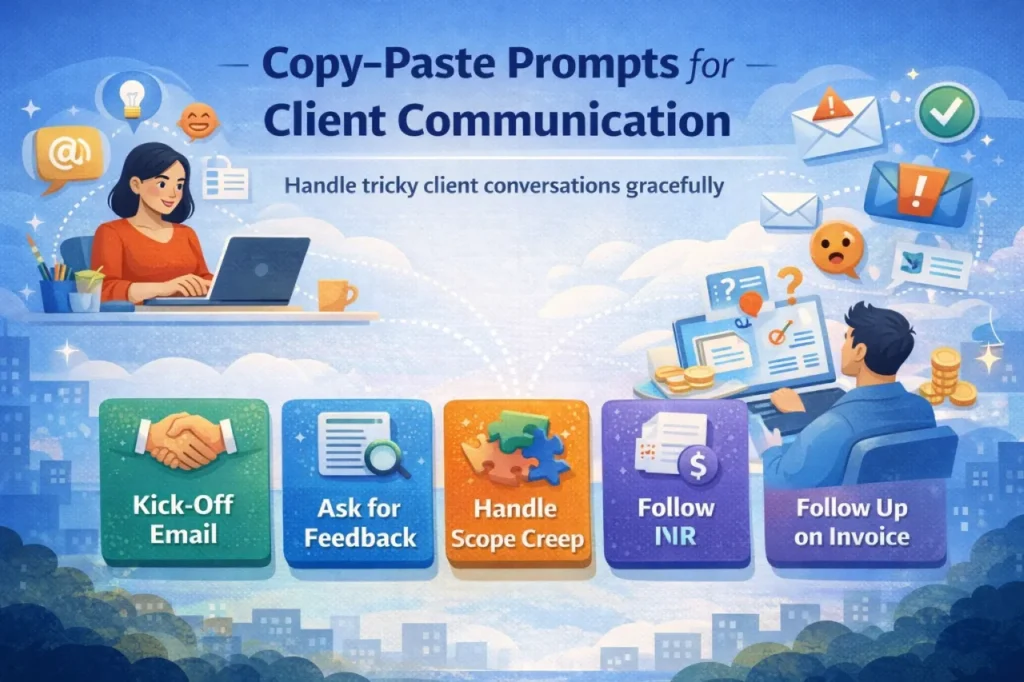
How you communicate decides whether a client becomes a long-term relationship or a headache. These prompts cover the conversations that actually happen — the awkward ones too.
Kick-Off Email After Signing a Contract ( Prompt 11 )
Write a professional kick-off email to a new client after they've signed the contract for [project type]. Include: a warm welcome, a summary of next steps, what I need from them and by when, and a link to our project timeline. Set a confident, organized tone that makes them feel they made the right choice.
Ask for Clearer Feedback ( Prompt 12 )
A client gave me vague feedback on my work — they said '[paste vague feedback]'. Write a professional reply that: thanks them, asks specific follow-up questions to understand what they want changed, and makes it easy for them to respond. Don't make them feel like they gave bad feedback.
Handle Scope Creep ( Prompt 13 )
A client is asking me to do [describe extra task] which is outside our original agreed scope. Write a polite but firm email that: acknowledges their request, explains that this falls outside our current agreement, offers to complete it as an add-on with a quoted price of [your rate], and makes it easy for them to say yes without feeling embarrassed about asking.
Send a Project Update ( Prompt 14 )
Write a brief mid-project update email to my client for [project type]. Completion is at approximately [X]%. This week I completed [tasks done]. Next steps are [upcoming tasks]. I need [anything you need from client] by [date] to stay on schedule. Keep it under 150 words and confident.
Follow Up on an Unpaid Invoice ( Prompt 15 )
Write a payment follow-up email for invoice #[number] for [amount], which was due on [date]. This is my [first/second/third] follow-up. Keep the tone professional and firm — not passive-aggressive, but not apologetic either. Include a direct link placeholder for the invoice and a clear deadline for payment.
Section 4: Prompts for Delivering Work
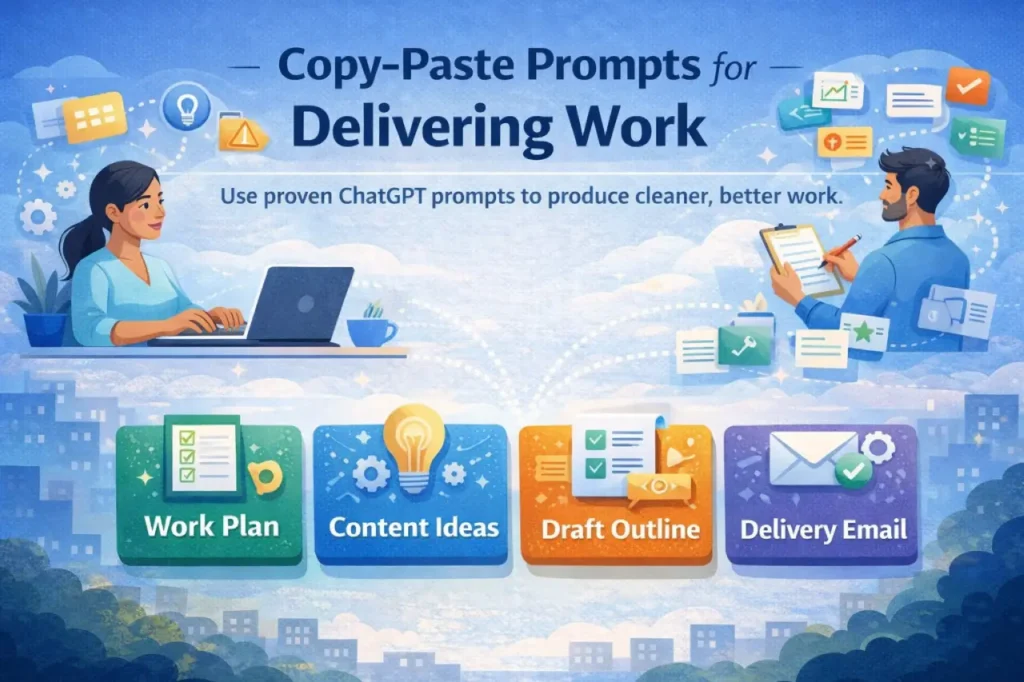
This is where the actual service happens. Use these prompts to think faster, produce cleaner work, and deliver more than the client expected.
Turn a Client Brief Into a Work Plan ( Prompt 16 )
Here is a client brief I just received: [paste brief]. Turn this into a clear to-do list with deliverables, sub-tasks, and a suggested timeline. Flag anything that's unclear or missing from the brief that I should ask the client before starting.
Generate Content Ideas for a Client ( Prompt 17 )
My client runs a [type of business] in [industry]. Their audience is [describe audience]. Generate 15 content ideas for their [blog/LinkedIn/newsletter] that: address real pain points, avoid generic topics, and position them as a thought leader. For each idea, add a one-line note on why it would perform well.
Write a First Draft Outline ( Prompt 18 )
Create a detailed outline for a [content type — e.g., 1,500-word blog post] titled '[working title]' for a [type of client] targeting [their audience]. Include: a hook angle for the intro, 4–6 main sections with sub-points, and a suggested conclusion or CTA. Don't write the full piece yet — just the structure.
Edit for Clarity and Tone ( Prompt 19 )
Edit the following text for clarity, tone, and readability. The target audience is [describe audience] and the tone should be [professional/conversational/authoritative — pick one]. Remove fluff, fix passive voice, and tighten every sentence. Don't change the meaning. Here's the text: [paste your draft]
Write a Delivery Email With Context ( Prompt 20 )
Write a delivery email for the completed [project type] I'm sending to my client [name or 'the client']. The key highlights of what I've delivered are [briefly list 2–3 things]. Mention next steps [revision window, go-live date, etc.] and invite their feedback in a way that's open but structured. Keep it warm and confident.
Section 5: Prompts for Building Your Personal Brand
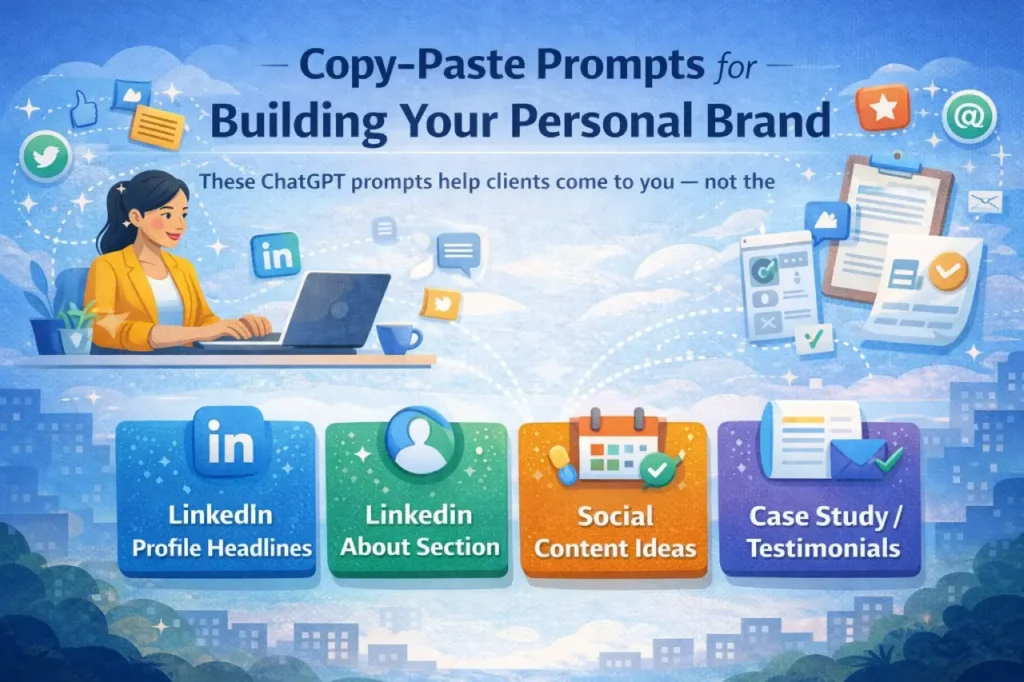
Your personal brand is what gets clients to come to you instead of the other way around. These prompts help you show up consistently and professionally.
Write Your LinkedIn Headline ( Prompt 21 )
Write 5 versions of a LinkedIn headline for a freelance [skill] who specializes in [niche]. My target clients are [describe]. Each version should be under 220 characters, lead with value (not my job title), and make a potential client want to click my profile. Avoid buzzwords like 'passionate' or 'guru'.
Write Your LinkedIn About Section ( Prompt 22 )
Write my LinkedIn About section for my freelance [service] business. I work with [type of clients] to help them [specific outcome I deliver]. My biggest strengths are [2–3 skills or approaches]. Start with a hook that speaks to my ideal client's pain point — not with 'I am a…' End with a clear, natural CTA to message me or visit my portfolio.
Create a Month of Social Media Content Ideas ( Prompt 23 )
I'm a freelance [skill] who posts on [platforms — e.g., LinkedIn and Instagram]. My target audience is [describe]. Generate a content plan for one month with 3 posts per week. Organize by content pillar: [Pillar 1 — e.g., Tips & Education], [Pillar 2 — e.g., Behind the Scenes], [Pillar 3 — e.g., Results & Social Proof]. For each post idea, include the topic, a suggested hook, and the format (carousel, short-form text, case study, etc.).
Write a Case Study ( Prompt 24 )
Help me turn this client project into a case study for my portfolio. Project: [brief description]. Client type: [industry, company size]. Problem they came to me with: [describe]. What I did: [your process]. Results: [outcomes, if any]. Write it in a story format — problem, process, result — with a professional but human tone. Under 400 words.
Draft a Testimonial Request Email ( Prompt 25 )
Write a short email to a past client asking for a testimonial. The project we worked on was [describe briefly]. I want the testimonial to be specific, not just 'great to work with.' Include 3 optional guiding questions they can answer to help them write something useful. Keep the email warm and easy to respond to.
Section 6: Prompts for Business & Admin
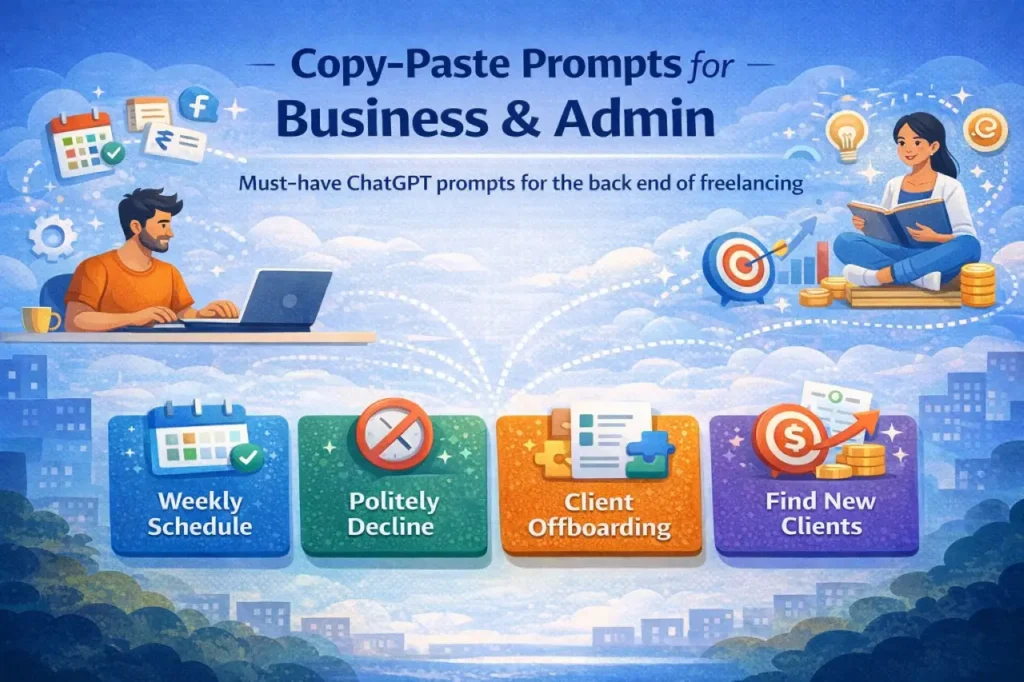
The part of freelancing nobody talks about — but everyone struggles with.
Create a Weekly Schedule ( Prompt 26 )
Help me create a realistic weekly schedule for a freelance [skill] managing [X] active clients. I work [X hours per day] and need to balance: client delivery work, marketing and outreach, admin (invoicing, emails), and personal time. Build it as a day-by-day plan with time blocks. Include buffer time for unexpected tasks.
Write a “Not Available” Response ( Prompt 27 )
A potential client just reached out but I'm fully booked for the next [X weeks/months]. Write a professional reply that: politely declines the work for now, keeps the door open for future projects, asks if it's okay to follow up when I have availability, and leaves a strong impression. Don't sound like I'm turning down money carelessly.
Handle a Difficult Client Ending ( Prompt 28 )
I need to professionally end my working relationship with a client because [brief reason — e.g., ongoing scope creep, non-payment, poor communication]. Write an email that: states clearly that I won't be continuing beyond [date or project completion], thanks them for the opportunity, hands off any outstanding work professionally, and closes the door without burning it. Keep it factual, not emotional.
Plan a Dry-Season Strategy ( Prompt 29 )
I'm going through a slow period in my freelance [skill] business. Help me create a 30-day action plan to find new clients and generate income. Include specific daily actions across: outreach, content, networking, and service packaging. Prioritize the highest-ROI activities first. Be practical — not motivational.
Annual Freelance Business Review ( Prompt 30 )
Help me run an end-of-year review of my freelance business. Ask me 10 questions that cover: income vs. goals, client quality, service pricing, time management, personal growth, and what I want to change next year. After I answer, help me build a simple strategy for the next 12 months based on my responses.
How to Get Better Results From Any Prompt
Copy-pasting these as-is will get you 70% of the way there. To get the other 30%, apply these principles:
Give ChatGPT a role. Starting with “Act as a senior freelance consultant” or “You are an experienced copywriter” shifts the quality of the output dramatically.
Add context before the ask. The more background you give — your niche, your client’s industry, your tone — the less generic the output. Three sentences of context can double the quality.
Use follow-up prompts. If the first output is close but not right, don’t start over. Say: “Make it shorter,” “Make the opening punchier,” or “Give me 3 alternatives to the second paragraph.”
Keep a prompt file. When a prompt produces something genuinely useful, save it. Build your own library of 20–30 go-to prompts tailored to your exact work.
Never publish unedited output. Use ChatGPT as a first draft engine, not a replacement for your judgment. Read everything out loud before sending it to a client.
Final Thought
The freelancers getting ahead with AI aren’t the ones using the most tools. They’re the ones who’ve learned to ask better questions.
These 30 prompts cover the full arc of freelance work — from landing a client to billing them to maintaining your sanity in between. Start with the ones that match your biggest current challenge, and build from there.
The goal isn’t to replace your thinking. It’s to free up more time for it.