
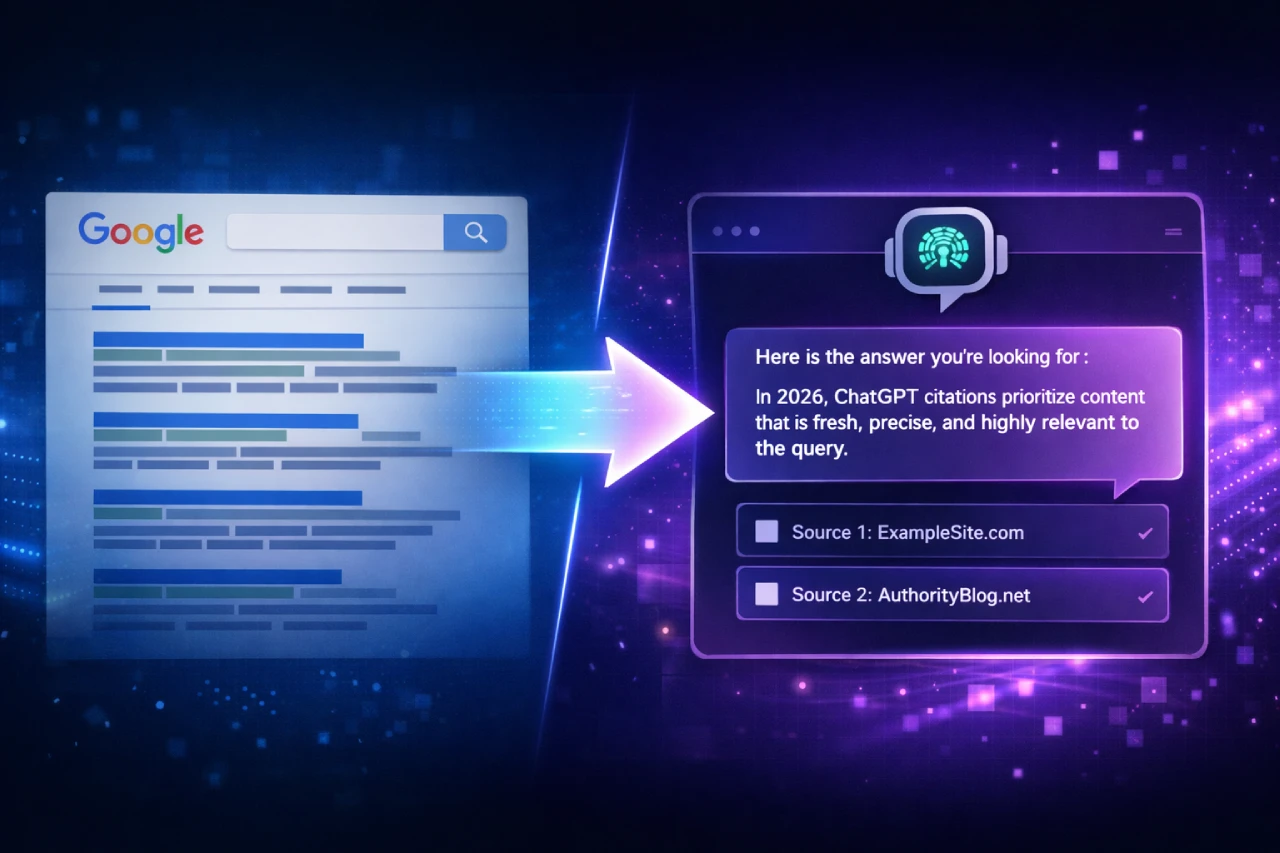
Something changed quietly in how people search. Millions of users now type a question into ChatGPT and read the answer directly — skipping the blue links entirely. If your content isn’t surfacing inside those answers, you’re invisible to a fast-growing share of your audience. This guide explains exactly how ChatGPT decides what to cite, and what you can do, today, to earn a place in those responses.
1. How ChatGPT decides what to cite
Before you can optimize for ChatGPT citations, you need to understand the mechanism behind them. ChatGPT doesn’t browse the internet the way a human does. When answering questions that require current information, it uses a process called Retrieval-Augmented Generation (RAG): it queries a search index, retrieves a set of candidate documents, and then synthesizes an answer from those documents — citing the ones that contributed most meaningfully.
Think of it like a research assistant who pulls five sources, reads them quickly, and writes a summary paragraph. The sources that get cited are the ones that clearly and directly answered the specific question being asked. Vague, padded, or overly promotional content gets used for background context — or ignored entirely.
The practical implication is significant: getting cited by ChatGPT is less about domain authority (the traditional SEO signal) and more about answer precision and content clarity. A well-structured post on a mid-sized site can outrank an enterprise brand if it gives a sharper, more direct answer.
Key insight: ChatGPT is not looking for the most authoritative source — it’s looking for the most useful source for the specific query. That’s a meaningful shift from traditional search ranking logic.
2. Two citation paths: live search vs. training data
There’s an important distinction most guides overlook: ChatGPT can surface your content in two entirely different ways, and your strategy for each is different.
Path A: Live search citations (with Browse / Search enabled)
When a user has web search enabled — which is increasingly the default in ChatGPT — the model queries Bing (and other sources) in real time. This means your content is only eligible if it’s currently indexed and ranking reasonably well. These citations appear with direct links and source labels in the response. This is where most of your near-term optimization energy should go, because it’s the fastest and most measurable path.
Path B: Training data influence
ChatGPT’s base model was trained on a massive corpus of web content. When no live search is triggered, the model draws on what it learned during training. Content that was widely cited, shared, and linked to on the web before the training cutoff will influence responses even without a live retrieval step. This path is slower to affect but durable — it shapes how the model “thinks” about a topic regardless of search settings.
For most content marketers, the highest-leverage move is optimizing for Path A now, while building the kind of authoritative, link-worthy content that earns Path B influence over time.
76%
25%
3x
of ChatGPT’s top-cited pages updated within 30 days
fresher on average than traditionally ranked content
more likely cited if content answers in first 100 words
3. The six factors ChatGPT looks for in a source
Based on current patterns in how AI citation works, here are the six content characteristics that consistently predict citation eligibility. These aren’t guesses — they reflect what happens when RAG systems evaluate documents for relevance and trustworthiness.
Direct answer density
ChatGPT favors content that answers the exact question asked — quickly and clearly. If your article takes 600 words to get to the point, RAG will often extract the answer and drop the attribution. Answers should appear early, ideally within the first two paragraphs of any section.
Factual specificity
Vague claims don’t get cited — specific ones do. “Email open rates are declining” gets skipped. “Email open rates dropped from 21.5% to 19.7% between 2022 and 2024 according to Mailchimp’s State of Email report” gets cited. Data points, percentages, named studies, and attributable facts are the currency of AI citations.
Topical authority signals
A single great article is less powerful than a cluster of deeply connected content on the same subject. ChatGPT’s underlying retrieval systems — and Bing’s indexing — reward sites that demonstrate consistent expertise on a topic. If your site covers 15 aspects of a subject with depth and precision, you build topical authority that increases citation probability across all of them.
Content freshness
Recency is a decisive factor for live search citations. AI models are acutely sensitive to publication and update dates, particularly for fast-moving topics. Review your most valuable content every 60–90 days and refresh any statistics, examples, or recommendations that have aged. A publish date of last month matters more than an impressive domain score.
Structural clarity
RAG systems extract information from documents. Well-structured documents — with clear headings, short paragraphs, and logical flow — are significantly easier for a retrieval system to parse and quote accurately. Dense walls of text, even if the content is strong, reduce extractability. Use headings that match natural language questions. Write paragraphs that stand alone as quotable units.
E-E-A-T signals (Experience, Expertise, Authoritativeness, Trust)
Google’s E-E-A-T framework directly influences whether your content appears in Bing’s index and how it’s weighted. Author bios, original research, citations of primary sources, and transparent editorial standards all contribute to E-E-A-T. Since ChatGPT’s live search relies heavily on Bing, E-E-A-T improvements boost your AI citation eligibility in parallel with your traditional search rankings.
4. Technical setup: making yourself citable
Content quality alone isn’t enough if your technical setup is blocking crawlers. Run through this checklist to ensure you’re not accidentally invisible to the systems that feed ChatGPT.
Crawl access
- Check your robots.txt file — ensure you haven’t accidentally blocked GPTBot, the OpenAI crawler. The directive to allow it is: User-agent: GPTBot / Allow: /
- Similarly allow Bingbot, which feeds ChatGPT’s live search. Confirm with Bing Webmaster Tools.
- Ensure all key content pages are in your XML sitemap and that the sitemap is submitted to both Google Search Console and Bing Webmaster Tools.
Structured data (Schema markup)
- Add Article schema with datePublished, dateModified, author, and publisher fields — these signal freshness and authorship to retrieval systems.
- For FAQ sections, implement FAQPage schema. This creates a structured question-answer pair that is highly extractable by RAG systems.
- For how-to content, use HowTo schema with clearly named steps.
The llms.txt file
A newer convention, borrowed from the logic of robots.txt, is the llms.txt file. Hosted at the root of your domain (yourdomain.com/llms.txt), it provides AI crawlers with a curated map of your most important content — essentially a guided tour of your site written for language models. While adoption is still early, several major AI systems have signaled support for this standard. Creating one now is a low-effort, forward-looking signal that positions you ahead of the curve.
Page speed and Core Web Vitals
- Slow pages that fail Core Web Vitals are deprioritized in Bing’s index, which flows through to ChatGPT’s live search. Target a Largest Contentful Paint (LCP) under 2.5 seconds.
- Avoid intrusive interstitials or overlays that block content from crawlers.
The best technical SEO is invisible — it removes friction between your content and the systems trying to read it. Every unnecessary crawl barrier is a citation you didn’t get.
— Core principle of Generative Engine Optimization (GEO)
5. How to write cite-ready content
This is where strategy meets craft. Writing for AI citations requires a slightly different editorial approach than traditional SEO copywriting — less focused on keyword density, more focused on what might be called answer capsule architecture.
The answer capsule method
An answer capsule is a self-contained, quotable block of text that directly answers a specific question in 40–80 words. It requires no surrounding context to make sense. When a RAG system retrieves your page and looks for something to synthesize into a response, it gravitates toward these capsules.
Practically, this means structuring key sections so that the first 2–3 sentences give the complete answer, and the following paragraphs provide supporting detail. The answer first; the evidence second. This is the inverse of how many writers are trained, but it’s how the most-cited content is structured.
Write for the question, not the topic
Traditional SEO targets a topic (e.g., “email marketing”). GEO targets a specific question (e.g., “what is a good email open rate for B2B SaaS?”). Use tools like Google’s People Also Ask, Reddit threads, and Quora to identify the exact questions your audience is typing. Build individual sections or even entire articles around single, answerable questions.
Cite your sources explicitly
One of the most underrated practices in AI-era content writing is explicit attribution within the body of your article. When you say “according to Statista’s 2024 Digital Marketing Report,” you’re doing two things: boosting your own E-E-A-T signals, and creating a fact-dense passage that AI systems find highly extractable. Don’t reference data vaguely — name the source, the year, and the specific finding.
Use natural, conversational headings
Headings like “Section 3: Methodology” tell a human reader where they are. Headings like “What does ChatGPT actually look for in a source?” tell a retrieval system exactly what question this section answers. Rephrase your H2 and H3 headings as natural language questions wherever appropriate — it dramatically improves extractability.
Maintain a consistent publication cadence
Fresh content is cited more often. That doesn’t mean publishing daily — it means building a realistic schedule you can sustain, and committing to refreshing existing content on a regular cycle. A site that publishes two well-researched pieces per month and updates its top articles quarterly will out-cite a site that publishes daily but never refreshes its content.
6. How to measure your AI citation visibility
This is the section most guides skip, because it’s genuinely harder to measure than traditional search rankings. But it’s not impossible — and having even a rough measurement framework is far better than flying blind.
Manual citation auditing
Start simple. Take your 10 most important target queries — the specific questions your audience asks — and type each one into ChatGPT with Browse enabled. Does your site appear as a cited source? If yes, take note of which content earned the citation. If no, study what did get cited and analyze what it does that yours doesn’t. This manual process, done monthly, gives you a directional read on your citation visibility.
Brand mention tracking
Set up alerts for your brand name, domain, and key bylines using tools like Google Alerts, Mention, or Brand24. While these won’t capture every AI citation directly, they’ll catch the secondary effect: when AI responses cite your content, readers who trust the answer sometimes follow up by searching your brand name or visiting your site. An unexplained uptick in branded search traffic is often an early signal of AI citation activity.
Emerging AI analytics tools
The category of tools built specifically to track AI citation visibility is young but growing fast. Platforms like Semrush and Ahrefs have started integrating AI visibility tracking into their dashboards. Dedicated tools like Otterly.AI and Profound are built specifically for this purpose. Check current reviews before committing — this space is evolving quickly and product capabilities change rapidly.
The traffic signal
Keep an eye on your referral traffic sources in Google Analytics. OpenAI’s browsing feature can generate referral visits tagged from ChatGPT’s domain. This won’t capture every citation — many users read the AI’s synthesized answer without clicking through — but measurable referral traffic from AI platforms is a reliable indicator that your citations are driving engagement.
Frequently asked questions
No. Domain authority is one input among many, and it’s less decisive in AI citation than in traditional search. A highly specific, well-structured answer on a lower-authority site can and does outperform a generic overview on a major platform. Content quality and answer precision matter more.
For live search citations, the timeline roughly mirrors Bing indexing — anywhere from a few days to a few weeks after publishing, assuming your technical setup is in order. For training data influence, the cycle is measured in months to years and depends on how widely your content gets linked to and shared.
Rarely, for live search citations. If your content requires a login to access, GPTBot and Bingbot typically can’t index the full text, which means they can’t retrieve and cite it. For high-value gated content, consider making the first section or a summary publicly accessible to crawlers using a “first paragraph free” approach.
Generative Engine Optimization (GEO) is the practice of optimizing content to appear within AI-generated responses — rather than just ranking in a list of blue links. SEO targets search engine result pages; GEO targets the AI answer layer that increasingly sits above those results. The two disciplines share many foundations (quality content, technical hygiene, E-E-A-T) but GEO places greater emphasis on answer density, structured formatting, and content extractability.
That’s a legitimate concern, and the decision involves trade-offs. Blocking GPTBot protects your content from being used in OpenAI’s training data without compensation. But it also removes you from eligibility for ChatGPT live search citations. If citation visibility is a marketing goal, blocking GPTBot works against that goal. Most publishers focused on distribution are choosing to allow access and monitoring the results.
Indirectly, yes. Backlinks and social shares contribute to Bing’s indexing signals, which influence ChatGPT’s live search pool. Content that earns links from reputable sources also tends to rank higher in Bing, increasing the probability of being in the retrieval candidate set. However, backlinks alone don’t guarantee citations — the content still needs to be the best available answer to the specific query.