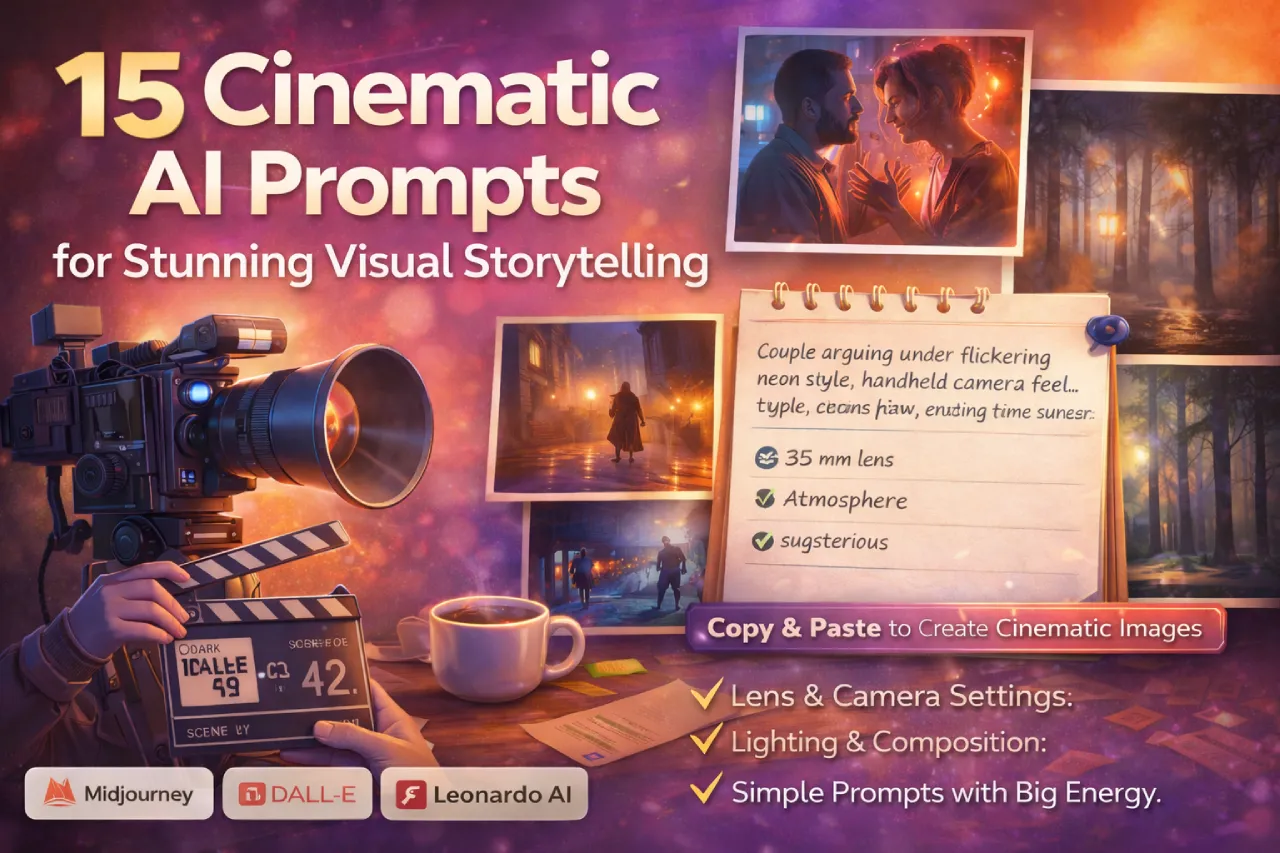
You can spot a cinematic frame from a mile away. It’s usually not the sharpness or how “HD” it looks. It’s the feeling sitting inside the image. That soft rim light hugging the subject’s hair. The way dust floats through a beam of sunlight. That tiny pause between two actions where a story quietly breathes.
AI can recreate the look of cinema pretty easily now. But making it feel cinematic? That still comes down to words. The right words, in the right order, with the right intent behind them.
This post isn’t about flashy movie-poster tricks or overdone lens flares. It’s about story energy. About writing prompts that pull emotion out of pixels and make an image feel like a frame ripped straight out of a film.
Honestly, once you understand how cinematic prompts work, you stop chasing “cool images” and start directing scenes instead.
Why Cinematic Prompts Hit Different
It’s About Mood, Not Megapixels
Cinema has always been about mood first. A strong cinematic frame should whisper context even before anything moves. You should feel the tension, the calm, the loneliness, or the romance without needing an explanation.
Lighting does most of that work. Color finishes the job.
A single practical light source, like a streetlamp or a window, can tell more story than a dozen flashy effects. The shadows matter just as much as what’s visible. Sometimes even more.
That’s where most AI images fall apart. They try too hard to look impressive and forget to feel believable.
Cinematic Language in Prompts
Here’s the thing: cinematic prompts work best when you speak in film language, not generic adjectives.
Instead of saying “beautiful” or “dramatic,” use words filmmakers actually think in:
- Camera: 35mm, 50mm, 85mm, handheld, tracking shot, static frame
- Lighting: key light, rim light, practical light, sodium vapor lamp
- Tone: noir, desaturated, warm grain, low contrast
Once you start writing like this, AI responds differently. It stops guessing and starts composing.
How to Structure a Cinematic AI Prompt
There’s no single perfect formula, but after years of experimenting, this structure works consistently well.
1. Subject + Action
Who is in the scene, and what are they doing right now?
2. Lighting + Environment
Where is the light coming from, and how does it shape the mood?
3. Camera + Composition
Lens choice, framing, angle, and depth of field.
4. Color Grade + Emotion
What should the image feel like emotionally?
A simple example:
Woman running through a narrow alley at dusk, handheld 35mm shot, rain reflections on cobblestones, bluish cinematic grade, motion blur on fabric.
Short, visual, and intentional.
Now let’s get into the good stuff.
This Is We Have Best World Class Prompt for That
Below are 15 production-ready cinematic AI prompts designed for real visual storytelling. These aren’t random ideas. Each one is structured like a film shot, with lighting logic, camera intent, and emotional weight.
You can copy them, tweak them, or use them as a base for your own scenes.
Neon Argument (Drama)
A young couple frozen mid-argument beneath a flickering neon motel sign at night, rain-soaked pavement reflecting red and cyan light; tension visible in clenched jaws and half-spoken words; single sodium streetlamp acting as key light, harsh side lighting carving faces, soft rim glow on wet hair; handheld 35mm lens, eye-level framing, shallow depth of field; moody blue-magenta color grade, subtle film grain, emotional realism — ar 16:9.
The Waiting Bride (Melancholy)
A bride standing alone on an empty train platform at night, veil gently lifted by passing wind, train lights fading in the distance; cold tungsten overhead lamps casting long, lonely shadows; static 50mm lens, centered composition, deep background falloff; desaturated palette, soft grain, quiet heartbreak, cinematic stillness — ar 21:9.
Shared Silence in Rain (Romance)
Two close friends walking under a single umbrella during summer rain, shoulders nearly touching, unspoken comfort; warm backlight from the setting sun diffused through rain, reflections shimmering on wet asphalt; 35mm lens, medium-wide framing, shallow DOF; golden-hour warmth, natural skin texture, gentle motion blur on falling rain — ar 4:5.
Actor Mid-Tear (Intimacy)
Extreme close-up portrait of an actor seconds before breaking down, a single tear suspended on the lower eyelid; isolated stage spotlight as key light, rapid falloff into pure black; 85mm lens, razor-thin depth of field, eyes in perfect focus; neutral color science, realistic pores, restrained film grain — ar 4:5.
Rooftop Slow Dance (Romantic Nostalgia)
A couple slow-dancing on a rooftop at twilight, city skyline softly glowing behind them; cool ambient sky light with warm rim light outlining silhouettes; 50mm lens, medium shot, gentle camera stillness; creamy highlights, soft contrast, subtle motion in fabric, timeless romance — ar 16:9.
Tunnel Run (Action)
A motorcyclist tearing through an underground tunnel at night, sparks trailing from metal scraping asphalt; sodium vapor lights streaking overhead, hard directional contrast; low-angle tracking shot, 35mm lens, controlled motion blur; gritty texture, cinematic grain, raw speed — ar 21:9.
First Step Into the Temple (Adventure)
An explorer cautiously entering an ancient stone temple, torchlight revealing carved faces and dust-covered walls; warm practical firelight cutting through darkness, volumetric dust in the air; wide 24mm lens, low perspective; earthy tones, realistic stone texture, sense of discovery — ar 16:9.
Searchlight in the Storm (Suspense)
A helicopter searchlight slicing through heavy storm clouds at night, rain and mist swirling in turbulent air; cold moonlight ambience with sharp white beam contrast; distant wide shot, 70mm lens compression; dramatic scale, cinematic grain, controlled highlights — ar 21:9.
The Collapsing Bridge (High Stakes)
A lone hero sprinting across a collapsing bridge as debris falls into fog below; harsh backlight blasting through smoke, silhouettes breaking apart; wide 28mm lens, dynamic framing, intense motion blur on debris; desaturated action grade, tactile realism — ar 21:9.
Breaking the Surface (Survival)
A diver bursting upward through dark water toward piercing sunlight, bubbles racing past the lens; strong top-down natural light scattering underwater; wide underwater lens with natural distortion; teal-orange cinematic grade, floating particles, immersive depth — ar 16:9.
Midnight Diner (Loneliness)
An empty roadside diner at midnight, neon signage casting pink and cyan light across chrome counters; rain streaking down the windows, reflections trembling; static 35mm lens, symmetrical composition; low-contrast noir palette, quiet isolation — ar 16:9.
Fog and First Light (Atmosphere)
A dense forest at sunrise, fog rolling between tall trees as golden light breaks through; soft natural shafts illuminating drifting mist; 35mm lens, eye-level framing; muted greens, organic grain, peaceful anticipation — ar 16:9.
The Empty Theater (Memory)
A small child standing alone in a dark theater holding a red balloon, single projector beam illuminating floating dust; warm practical light against deep shadows; medium shot, 50mm lens; nostalgic tones, gentle contrast, emotional stillness — ar 4:5.
After the Rain (Urban Mood)
An abandoned city street just after rainfall, puddles mirroring streetlights and empty buildings; cool ambient night light with subtle reflections; handheld 35mm feel, slight camera imperfection; restrained color palette, cinematic grain, quiet aftermath — ar 16:9.
Window Light (Timeless Story)
An elderly man sitting beside a window in the late afternoon, sunlight catching dust particles in the air; soft directional natural light wrapping his face, gentle shadow falloff; 85mm lens, intimate framing; warm low-contrast grade, realistic skin texture, contemplative silence — ar 4:5.
Common Cinematic Mistakes in AI Images
Even with great prompts, a few mistakes show up again and again.
Over-contrast is a big one. Pushing HDR too hard kills mood fast. Movies breathe in shadows; they don’t crush them.
Lens flare spam is another. A little flare can feel cinematic. Too much and the image instantly looks fake.
Conflicting light directions happen a lot too. AI loves adding extra suns for no reason. If your key light is warm, your shadows shouldn’t be icy blue.
And over-saturation? That’s a realism killer. Real film color is usually restrained, not loud.
Pro Tricks for Film-Quality Rendering
A few small additions can level up results instantly:
- Use aspect ratios intentionally. 21:9 for wides, 4:5 for portraits.
- Add phrases like film grain, cinematic contrast curve, or vintage Kodak tone.
- Keep light temperature consistent across the scene.
- Save seeds if your model supports it. Shot continuity matters more than people think.
In simple words, treat each image like a film frame, not a wallpaper.
FAQs
Because they mimic how our eyes and brains expect light to behave in stories—controlled chaos.
Yes, but Midjourney v6 and Leonardo AI handle cinematic contrast best.
Always. Micro-expressions anchor realism.
Skip “ultra-sharp”; use “natural focus fall-off.”
Add “film grain” and “lens imperfections.” It hides AI smoothness.
Reuse the same seed and lighting cues; change only the action line.
Final Thoughts
Cinematic AI prompts aren’t about showing off technical skill. They’re about directing emotion. When you focus on story, light, and camera intent, the visuals naturally fall into place.
You don’t need longer prompts. You need clearer ones.
If an image feels like it could pause a movie for half a second and still tell a story, you’re doing it right.
Play with these prompts. Break them. Remix them. That’s how your own visual language starts forming. And honestly, that’s the fun part.